
Security approach for private workflow automation
This page describes the design questions and control points used for sensitive workflows. It is an implementation approach, not a certification or a blanket security guarantee.
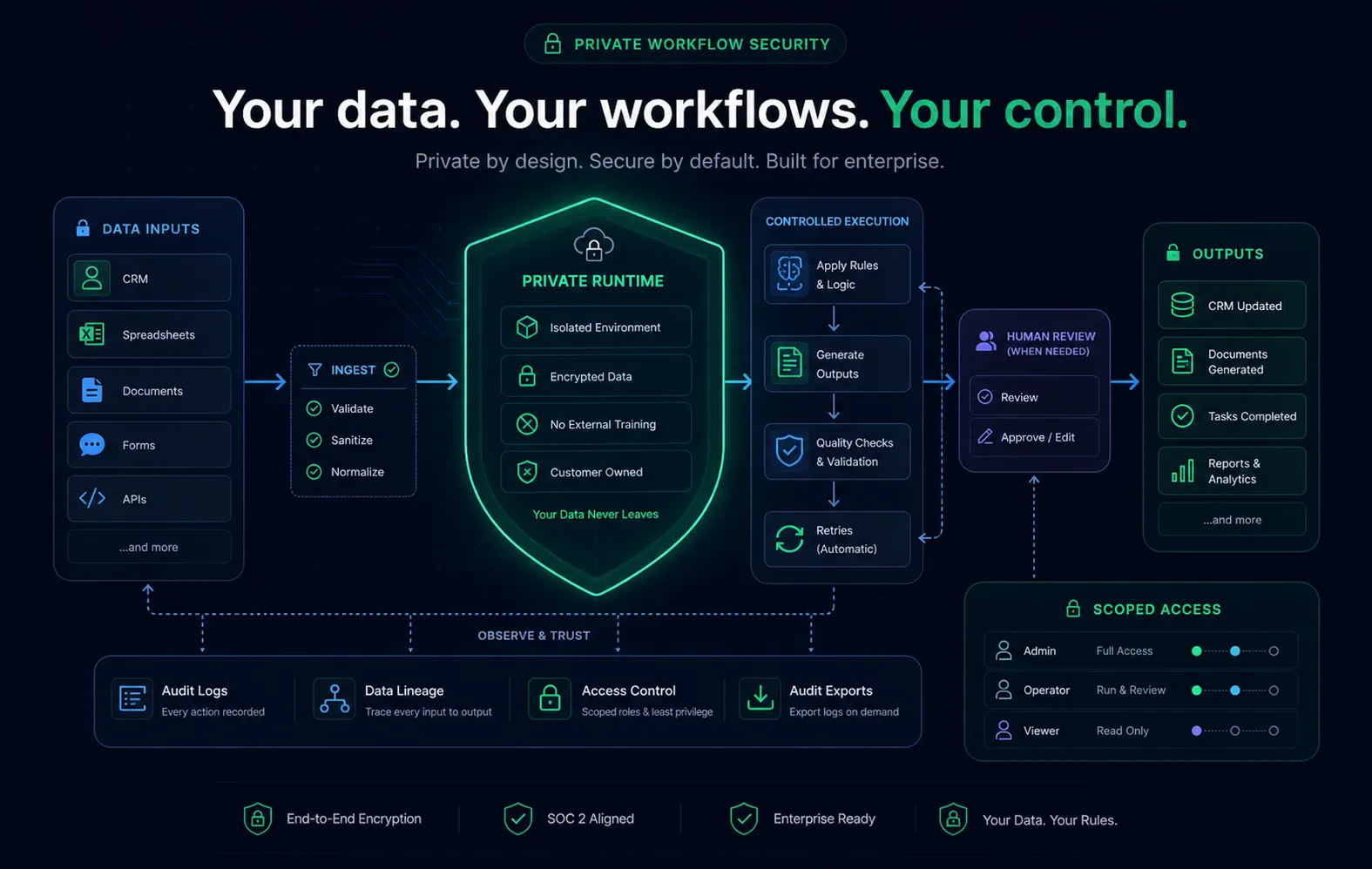
CONTROL POINTS TO CONFIRM
Security decisions belong in the engagement scope
The controls below are questions to answer with the client and relevant providers. They are not blanket claims about every deployment.
Access and credentials
Define owners, scoped keys, least-privilege access, and revocation steps.
Encryption and transport
Record the storage and transfer controls required by the workflow and environment.
Retention and deletion
Agree what logs, inputs, outputs, and temporary files are retained and for how long.
Backups and recovery
Document backup ownership, recovery expectations, and failure handoffs before launch.
Human access and review
Identify when a person can inspect, approve, retry, or stop a workflow.
Incidents and subprocessors
Confirm incident contacts and any external providers before data is connected.
What this means
The workflow is designed around control, traceability, and minimal data movement.
Why it matters
Sensitive operations need more than a black-box tool with no operational visibility.
What we avoid
Loose integrations and blind data routing that are hard to audit.
How private automation is delivered
1. Scope
We map the workflow, inputs, approval points, and output format before any build starts.
2. Runtime
The automation runs inside your environment when needed, or in a tightly controlled hosted setup when approved.
3. Logging
Every run creates a traceable record so you can review inputs, outputs, and failures without guessing.
4. Recovery
Retries, approval steps, and human review gates are added where silent failure would be expensive.
Operational safeguards
- •Only the minimum fields required for the workflow are processed.
- •Retries are limited and visible, not hidden inside a black-box queue.
- •Human approval can be inserted before any external side effect happens.
- •We keep handoffs traceable so operations can audit what happened and when.
FAQ
Does all data leave my environment?
No. We favor private execution and only use external services when the workflow explicitly requires it.
What happens if a step fails?
Failures are logged and either retried or handed back to a human review step, depending on the workflow design.
Is this only for large teams?
No. Private automation is useful when the workflow is repetitive, sensitive, or expensive to do manually, regardless of team size.
Ready to automate?
Book a free diagnostic and we'll map your bottleneck.
Review Your Security Approach